QR Codes for Elders: Solution That Saves Lives
To create QR code for link, video or image - click on button below.

Article Plan
- Why QR Codes Work for Seniors
- QR Codes vs. Other Safety Solutions
- Real-World QR Code Programs for the Elderly
- What Information to Put in a QR Code for an Elderly Person
- How to Scan a QR Code: Quick Guide for Anyone Who Finds a Lost Senior
- Privacy Concerns: How Much Information Should a QR Code Show?
- A Small Code with a Big Impact
Every 3 seconds, someone in the world develops dementia. According to the World Health Organization, over 55 million people currently live with dementia globally – and that number is expected to reach 139 million by 2050. Alzheimer's disease accounts for 60–80% of all cases, gradually erasing a person's memory, orientation, and ability to communicate.
One of the most dangerous consequences is wandering. Studies show that 6 in 10 people with dementia will wander at least once. When a person doesn't remember their name, home address, or the faces of their relatives, every walk outside can turn into an emergency.
This is where QR codes for the elderly offer a simple, affordable, and proven solution – used across different cultures and healthcare systems. The key insight is elegantly practical: the person with dementia doesn't need to do anything. A passerby with a smartphone does the rest. Today, many organizations for senior citizens offer QR-based programs free of charge.
Why QR Codes Work for Seniors
When thinking about QR codes and seniors, the first question is: why not just a phone or GPS tracker? The answer lies in understanding how dementia affects behavior. Patients forget to charge devices. They remove watches and bracelets. They leave bags at home. In QR codes dementia programs worldwide, the key advantage is always the same: the technology requires nothing from the person wearing it. A GPS tracker in a keychain is useless if the patient walks out without their keys.
QR codes solve this by being passive, tiny, and impossible to accidentally switch off. A waterproof sticker on a fingernail, a badge sewn into a jacket, or a bracelet that looks like jewelry – these can stay with a person through any situation. QR codes for seniors ease of adoption come from requiring zero action from the person being helped.
Beyond individual use, QR codes scale remarkably well. Governments, nonprofits, and healthcare providers across six countries have adopted QR-based programs for their elderly populations – each adapting the format to local needs.
QR Codes vs. Other Safety Solutions
Not all safety solutions are equal. Here's how QR codes compare to the most common alternatives:
The table shows that QR codes outperform alternatives in most categories. Their only limitation – requiring a smartphone from the person who finds the patient – is increasingly irrelevant as smartphone adoption reaches over 90% in most urban populations worldwide.
What age group uses QR codes most in safety programs? Contrary to assumptions, it's not the elderly themselves – it's the working-age bystanders, caregivers, and family members who scan the codes on their behalf.
Real-World QR Code Programs for the Elderly
From Southeast Asia to North America, local governments and nonprofits have developed QR-based programs tailored to their communities. Here are six real cases that show what's possible.
Thailand – QR Bracelet (Mirror Foundation, 2018)
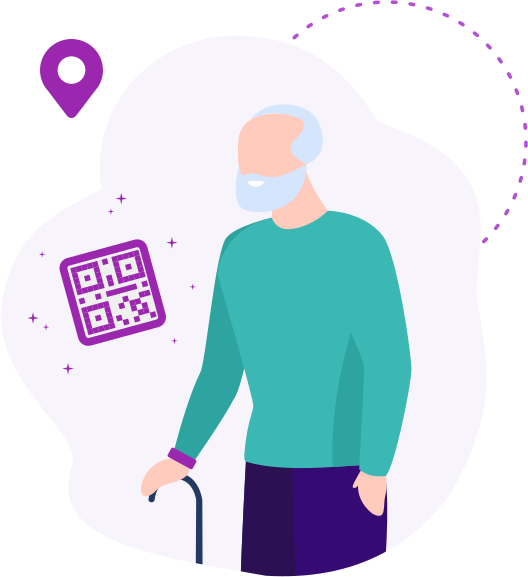
Thailand's Mirror Foundation receives around 30 calls every month from families desperately searching for elderly relatives with Alzheimer's who have wandered off. In 2018, the organization launched a QR bracelet program specifically designed for this problem.
What makes it different from a standard medical bracelet is the backend system. When a passerby scans the bracelet, the Mirror Foundation's database immediately receives the patient's map location information and dispatches medical assistance. Families can enroll any patient who provides a doctor's note confirming the Alzheimer's diagnosis. The program is open to everyone and free to join.
China – QR Badge on Clothes (2014)
In 2014, Chinese healthcare professionals tackled a common scenario: a patient leaves home lucid, walks to a nearby store, and suddenly can't remember their name or address. The solution was a QR badge worn on clothing – miniature, easy to attach, and always visible.
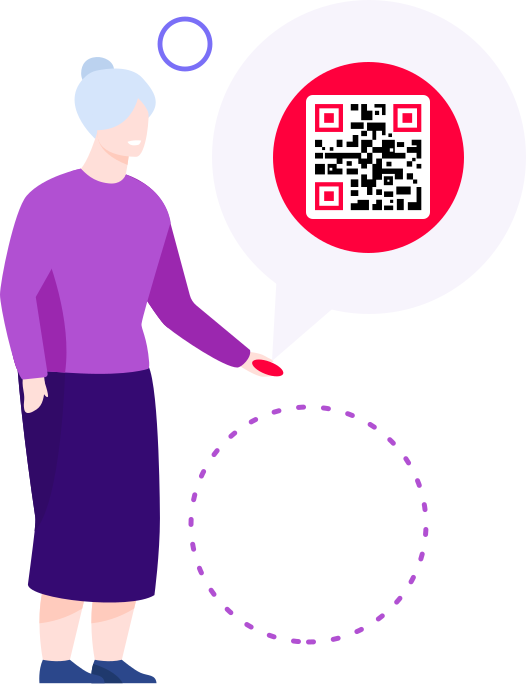
Each badge stores the patient's name, home address, diagnosis, and emergency contacts for relatives. A call to action is printed directly next to the code: "Scan to help get me home." Any passerby seeing a confused older adult can immediately scan and contact the family. The practice has since spread beyond China, with similar QR codes on clothes for elderly programs appearing across Asia and Europe.
Japan – NailQ Sticker (Orange Links, 2015)
Japan has the world's oldest population – seniors are expected to make up one-third of the country by 2035. The city of Iruma near Tokyo faced a specific problem: GPS devices given to dementia patients were consistently forgotten at home or ran out of battery. The solution needed to be something a patient literally could not leave behind.
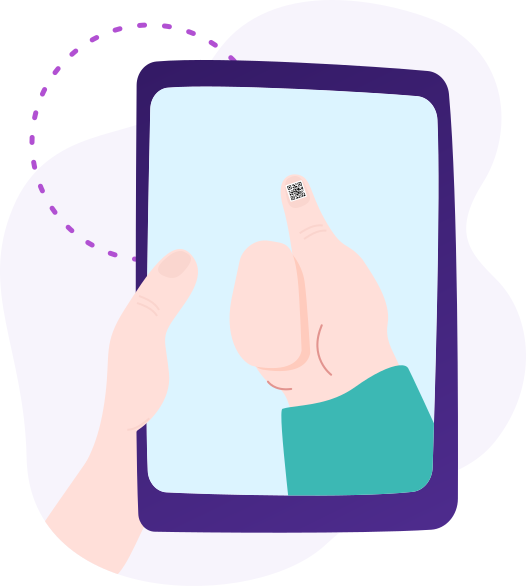
The answer came from company Orange Links in 2015: a gel QR sticker the size of a fingernail. Applied to a thumbnail or toenail, it's waterproof, lasts about a month, and can be read even if 15% of the code is damaged. The sticker shows a registration number and the city hall's phone number – minimal personal data by design.
The program costs under $2 per patient, and local governments distribute it free of charge. In 2019 alone, the NailQ sticker helped return five missing elderly residents to their families in Iruma City. The Japan QR dementia thumbnail sticker – applied directly to a fingernail – became one of the most copied innovations globally. Interest in the system has since come from Australia, Singapore, Hong Kong, and Taiwan.
India – Project Chetna (QR Locket)
Project Chetna took the QR concept a step further. Instead of a passive code, the initiative developed a smart QR locket worn around the neck. When someone scans it, the system automatically sends a notification to the registered family members – along with the scanner's IP address.
This dual-layer approach adds a layer of accountability: families know not just that someone found their relative, but have a way to trace who scanned the code. It's a particularly important feature in contexts where the identity of the Good Samaritan matters for follow-up. The project was developed as an NGO initiative and doesn't require government infrastructure to operate.
Spain – QR Program "No me olvides si me olvido"
Spain's QR program has deep roots: Madrid's city government launched a pilot initiative as early as 2014, placing QR codes on pendants, stickers, and bracelets for Alzheimer's patients at its day care centers. The pilot was formalized in 2017 when the Community of Madrid partnered with the Fundación Gozalbo-Marqués to launch the program "No me olvides si me olvido" – "Don't forget me if I forget."
The initiative distributed 5,000 QR bracelets free of charge to residents over 65 with early-stage dementia. Each bracelet stores the patient's name, address, blood type, allergies, medications, and emergency contacts. To receive one, families submit a medical diagnosis and a social services assessment at their local municipality office. It's a strong example of how government agencies can deploy simple technology at scale within a European healthcare and social care system.
USA – MedicAlert + Safe & Found
In the United States, the MedicAlert Foundation – established in 1956 – partnered with the Alzheimer's Association to create the Safe & Found program. Members receive a QR-enabled medical ID bracelet or necklace linked to a 24/7 emergency response center.
When a MedicAlert member is reported missing, the center immediately distributes bulletins to local hospitals and law enforcement. If a Good Samaritan finds the person and scans their bracelet, they're connected directly to the emergency center. The latest Smart ID product combines a QR code with an Apple AirTag for real-time location tracking – a rare case where QR and GPS work together rather than as alternatives. QR codes on clothes for elderly in America are another popular option – chosen by families whose relatives tend to remove bracelets or jewelry.
A notable grassroots example: seventh-grade students from Pottsville, Arkansas designed QR code keychains and tags for a local senior behavioral health program – inspired by rising numbers of missing seniors on social media. They presented 30 handmade QR tags to program staff in January 2025.
What Information to Put in a QR Code for an Elderly Person
Creating a QR code for elders is straightforward with any modern QR generator. The harder question is what to include. Here is a recommended checklist – you can use a vCard format, a custom URL linking to a private profile page, or a simple text block depending on the tool you use:
- Full name and a recent photo (if using a URL-based profile);
- Home address;
- Diagnosis in general terms (e.g., "memory impairment");
- 2–3 emergency contacts – family members or caregivers with phone numbers;
- Blood type;
- Known allergies;
- Current medications and dosages;
- Primary care physician contact;
- Call to action for the finder: "Please help me get home" or "Scan to contact my family";
- Insurance number (optional, depending on privacy preferences).
If you want to go beyond a static code, platforms that offer dynamic QR codes let you update the information without reprinting the code – ideal as medical situations change. You can also link to a Google forms page where the finder can leave their contact details, or use phone call and e-mail QR types for direct one-tap contact.
To create a QR code for a link, video or picture - click on the button below.
How to Scan a QR Code: Quick Guide for Anyone Who Finds a Lost Senior
For a senior citizen QR system to work, any passerby needs to be able to scan it confidently. The good news: no special app is needed on modern smartphones. Here's how:
- Open the default camera app on your iPhone or Android phone.
- Point the rear-facing camera at the QR code – hold steady for 1–2 seconds.
- A notification or link will appear at the top of the screen.
- Tap the link. A page with the person's information and contact details will open.
- Call the listed emergency contact or follow the instructions on the page.
On older iPhones (before iOS 11), you may need to download a free App markets QR reader. Search "QR code scanner" in the App Store or Google Play. For step-by-step QR reader for iPhone instructions for seniors, some QR generator platforms like Me-QR provide printable guides in large font.
Privacy Concerns: How Much Information Should a QR Code Show?
Not everyone is comfortable with the idea of a stranger scanning a code and seeing a patient's full medical history. Critics have called some implementations dehumanizing – likening patients to objects with barcodes. This is a legitimate concern, and different programs handle it differently.
Japan's NailQ sticker takes a minimalist approach: the code reveals only a registration number and the city hall's phone number. No name, no address, no diagnosis. The personal information lives in a secure database, accessed only by authorized staff after a call. The Spanish and Thai programs follow similar principles.
India's Project Chetna adds another layer: the family is notified when the code is scanned, along with the scanner's IP. This creates accountability without exposing data to the public.
The right balance depends on the family's priorities. If speed is paramount – a stranger needs to act immediately without making a call – more data in the code makes sense. If privacy is the priority, a registration number with a hotline works well. Many platforms offer dynamic codes where the privacy settings can be adjusted without reprinting the physical code.
A Small Code with a Big Impact
QR codes won't cure dementia. But across six countries – Thailand, China, Japan, India, Spain, and the United States – they have proven that a simple, affordable piece of technology can make a meaningful difference in the safety of elderly people with memory disorders.
The beauty of the solution is its simplicity. No subscription required. No device to charge. No app for the patient to learn. A sticker, a badge, or a bracelet – choose the format that works for your relative's lifestyle. Fill it with the right information. And know that if they ever get lost, any person with a smartphone can help bring them home.
You can create a QR code for elders today using any of the major QR platforms. Whether you choose a URL linking to a private profile, a vCard with contact details, or a QR code with text block – the most important step is the first one: getting started.